Model 210BR
Since 2004 the model 210BR percent oxygen analyzer
and the 2010BR trace oxygen analyzer have been the unquestioned market
leaders, the industry-standard hazardous area oxygen analyzers. Over
the years it has been continuously refined to the point that it now
provides every feature you can possibly need – and many that you may not
have thought of - in a compact, easily installed low-cost package.
Many thousands of these analyzers are operating to specification in the
harshest environments all over the country.
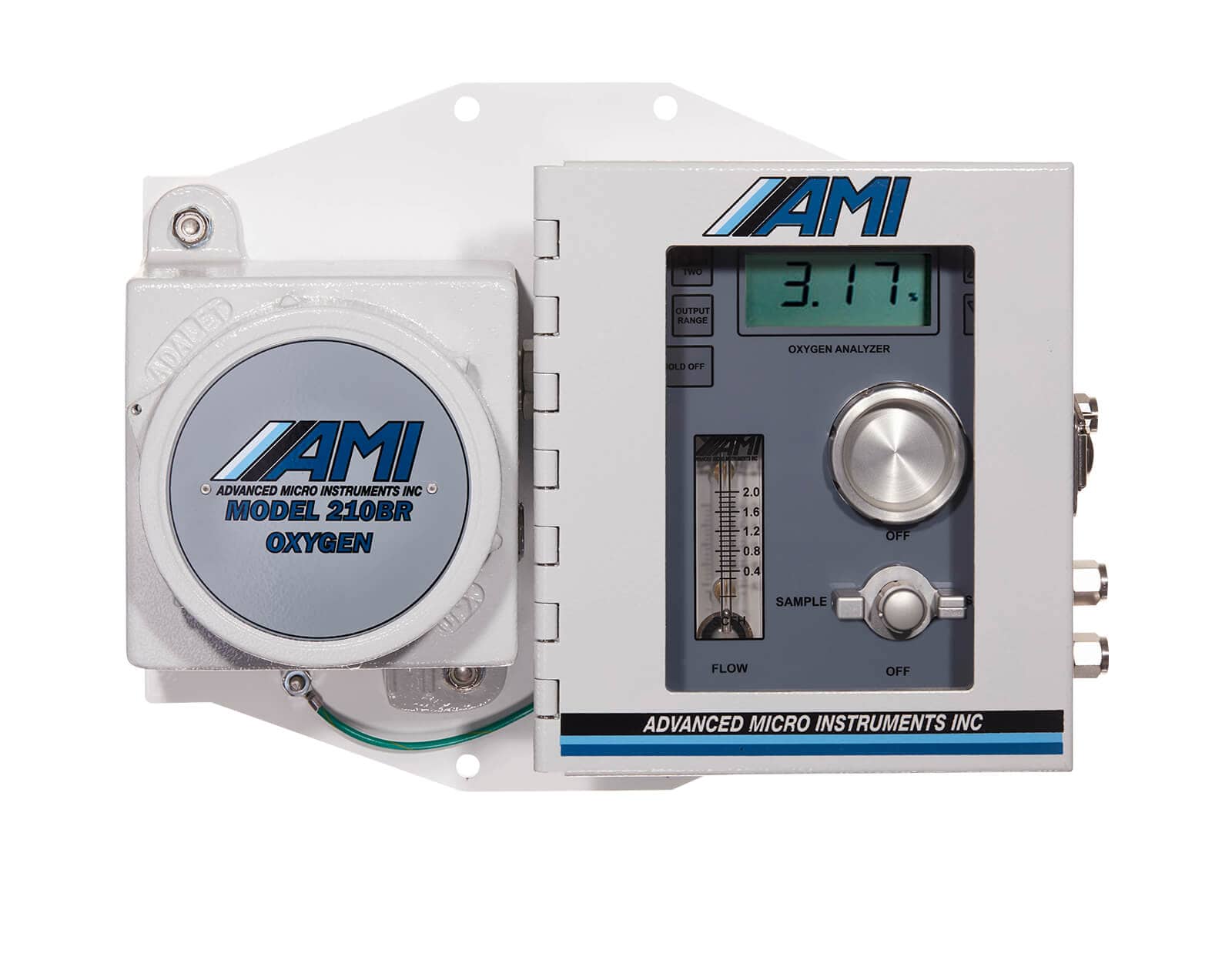
The 210BR is built with exactly the same cell block
as the best-selling 2010BR trace oxygen analyzer. All sample handling
components – the flow meter, needle valve and a four-way sample/span
selection valve – are integrated into a solid metal block. Connections
between them are drilled passages. The result is a highly reliable
sample system with all necessary components provided, and very fast
response.
AMI makes several versions of its patented
metal-bodied sensor for percent ranges. The P-2 sensor uses a basic
electrolyte for inert background gases, while the P-3 sensor uses an
acidic electrolyte for background gases that contain CO2. The P-3
resists H2S up to 10ppm H2S content, while the P-5 can resist up to
500ppm of H2S.
The sensor is immediately accessible on the front
panel of the analyzer, and can be replaced in seconds. It is not
necessary to expose the sensor to air unshorted as is the case with most
analyzers, thus further reducing the time from installation to
operation. As a result, although a span gas port is provided, it is
practical to accurately and quickly calibrate this analyzer on air.
For low temperature operation an integral
explosion-proof heater can be supplied. This unit directly heats the
cell block and thus is extremely efficient, allowing operation off a
solar panel system down to -20°F. For extreme environments down to
-40°F, an outer insulated enclosure can be supplied, but no additional
power is required.
The analyzer is approved by CSA for operation in a
Class 1 division 1 Group BCD hazardous area with a flammable gas as the
sample. No additional safety barriers are needed. The analyzer can be
calibrated and sensor replaced without declassifying the area because
the analytical electronics are intrinsically safe, protected by internal
safety barriers.
The electronic and software package is exceptionally
complete, and all features are provided as standard with no additional
cost (except for the heater). It is capable of operating off a battery
and solar panel, and it logs power brown outs and failures should they
occur. It tracks the temperature of the analyzer and the sensor. It
tracks the life of the sensor and indicates how much life is left. It
logs the calibration history. It logs the readings over its operational
(output) range.
The analyzer can be wall-mounted with 4 externally
accessible screws, or bolted to a 2” pipe using standard U bolts.
OVERVIEW
- Display reads percent oxygen from 0.00% up to 25% with no range changes
- Analog output and alarms can be configured to operate over any of 4 ranges from 0-1% to 0-25% for best resolution
- Field selectable analog output - 1-5V or 4-20mA, isolated.
- CSA approved to meet Class 1 Div. 1 Group BCD with a flammable sample requirements
- Complete sample system built in to the patented cell block.
- Easily replaceable sensor, no tools required.
- P-3 sensor resistant to 10ppm H2S standard, P-5 resistant up to 500ppm H2S optional..
- Simple, versatile installation.
- Operates either off 117VAC or 10-28VDC with very low power consumption
- Available integral explosion-proof heater for cold environments
- Analog output can be calibrated to a SCADA system or flow computer.
- 2 independent, fully adjustable alarm settings with relay contacts.
- Complete
alarm logic programming: latching or non-latching, open or close on
alarm, high alarm or low alarm, alarm-on delays and alarm hold-off.
- Integral data logger: Logs data for 15 days @ 1min intervals and 30 days @ 2min. intervals, etc.
- USB connectivity to a PC: Allows complete access to the internal functions.
- ModBus: Industry standard protocol over RS485.
- Oxygen Sensor life indication.
FEATURES
- 4 user selectable output ranges
- Optional low range to 0-1000ppm available
- 3 ½ digit LCD
- 2 fully adjustable oxygen concentration alarms
- Alarm delays
- Alarm hold off/Bypass
- RFI protected
- 1-5VDC or 4-20mA. isolated analog output signals
- Advanced analog output calibration to synch the analog output with any external monitoring system
- Data logger
- USB port for configuration and access to advanced features
- Modbus using Bidirectional RS485 for industry-standard communications
- Calibration history – stores the last five calibrations with time, date, span factor and calibration gas.
- Brown-out history – stores the last five brown-outs and recoveries.
- Power up history – stores the last ten times the unit was powered up.
- Advanced analog output calibration.
- Power requirements: Choice of 10-28VDC or 115VAC power
- Low minimum detection limit 0.01%
- Excellent repeatability
- Extended operating temperature range
- Fast upscale/downscale response times
- Patented
Cellblock Technology: Allows for all components such as: flow control
valve, flow meter, 3-way calibration valve, Sample/Span/Off and
compression fittings to be an integral part of the cellblock,
eliminating long lengths of tubing and fittings.
- Other
benefits of this design include: compact size, faster response times and
front panel sensor access without the need for tools.
- Area
Classification: Approved by CSA International to UL and CSA standards
as meeting requirements for Class 1, Div. 1, Groups B,C,D with a
flammable gas sample
- Unaffected by changes in flow rate from 0.1 to 2.0 SCFH
- Wall mount or 2.0” pipe
- Compact size
- 2 year warranty for analyzer, parts and labor
- 6 month sensor warranty, life expectancy 1-2 years
- Requires AMI User Interface Software